Yesterday started out kinda rough. Still pretty physically blah but felt a little better mentally. Made myself get out of the house and went to dinner with family. Drank a Ginger Ale and gave myself permission to order a kinda pricey salmon dish as I was saving $20 on the two glasses of wine I would have normally drank. Came home and invited the neighbors (the one I wanted a beer with on Friday) over. I felt strong enough to socialize. I had blown her off on a number of occasions, including Friday, and didn't want her to think it was her so I told her everything. She knows that I go through periods of drinking and not drinking, but did not know the extent of my mental issues around my addiction. I told her that I don't necessarily drink like an alcoholic but I definitely THINK like one which would undoubtedly lead me to eventually to drinking like one. Even if that never happened, I am just sick of trying to battle the obsessive/compulsive nature of my thoughts around alcohol. She is a super nice person but they are both pretty big drinkers, so I wasn't sure what her reaction would be.
After I was done telling her a brief history, where it had gotten to and about reaching out for help, she said, "You know I love you. I am so glad you talked to me about it. You need to have friends to talk to. I don't care if you drink or not and I think it is great you recognized you have a problem and are working on it."
I would call yesterday a success and today I feel much better about tackling a sober vacation.Vacations in the past have been exhausting. Thinking about drinking, drinking every day and waking up with a hangover almost every morning. I usually get back from vacations physically, mentally and emotionally exhausted. I have a great time, no doubt, but certainly do not feel relaxed and rested when I get home. I am going to try to have a different focus this vacation. Instead of hyper/party vacation full of selfish drinking, fighting and hangovers, I'm going to try a calm/restful vacation full of hiking, site seeing, dining and enjoying my family.
Sunday, July 29, 2018

Saturday, July 28, 2018
7/28/18 Bad Day
Yesterday was not good. My son has promised he would go on a hike with me. In my mind it was a reward for completing my IOP and getting all of my housework done. In his mind it was never a "for sure" thing. I waited for him to finally wake up only for him to say he didn't want to/couldn't bc he had too much to do and he was too tired.
My day just went off the rails. I was very disappointed which turned into being mad at him. Then, when outside, a neighbor said, "Want to get together for a beer later this afternoon?" which turned into me feeling sorry for myself bc I couldn't which turned into me getting really anxious about our upcoming vacation in which I can't drink. When he left to have lunch with a friend, I just sat in my room and cried. Then I binge watched Intervention. I did nothing all day and just felt really down in the dumps.
I even went as far as thinking, "My son doesn't even seem to care how disappointed I am. Maybe I will just have a beer and then he will know how upset he made me." How terrible is that! To make my son feel guilty for me having a beer! I couldn't believe I even thought this. That addictive voice is so selfish and conniving!
I am not going to lie - the thought of just letting go of all this silly sober stuff and having a beer with my friend and then being able to drink on vacation made me feel better. When I allowed myself to go to that mental place of justifying drinking, I really did feel my mood lift.
I also think the thought of my first sober vacation is really weighing on me. I drove to the airport on Wednesday and my thoughts went from excited bc next week I will be driving here to get on a plane for vacation to super excited bc my mind immediately went to being able to drink to disappointment that I can't drink (like I felt my shoulders slump) to worry and anxiety about having a sober vacation. All of these thoughts were out of my control and just flooded over me.
I didn't let myself stay in that place for too long for the fear of it sticking. I tried to "think it all the way through". If I had a beer with my friend, I would wake up tomorrow morning so mad at myself. I would think about the fact that it really didn't do that much for me and it wasn't worth how mad I would be the next day. It would also really increase my anxiety about vacation. I would be thinking things like, "Well I already screwed up. I might as well wait until after vacation to start again. It will be fine. My family might be a little disappointed in me, but they will get over it. I will show them that I can do it after vacation." Those voices become so strong they are sometimes hard to resist. I read that these voices are the hallmark of an addiction. Proof I am addicted to alcohol.
I also tried to think about the saying, "Life on life's terms." I don't really understand that saying but I think it might mean "ya, so you are having a bad day, your son bailed on you...everyone has bad days - you don't need a drug to make you feel better - that makes you a drug addict - it will pass - it is just a bad day - hopefully tomorrow will be better. Drinking may help you feel better in the moment bc you are feeding your addiction, but most certainly will not help you be free from shame and disappointment in yourself. Drinking is not the answer to making a bad day better as it makes your tomorrow worse. Also, you need to have this sober vacation. This is the perfect time to do it. You are only with your family - no drinking friends - who are supportive of your sobriety and will be super proud of you. Also, you may just have a relaxing, fun sober time. You will be so proud of yourself and it will be another really big milestone in your recovery"
I got over being mad at my son - like 10 hours later. I was really honest with my dh. He asked what would make me feel better. My immediate response was, "a beer." This made me think that the one disappointment in my day was really just getting my addiction becoming active and giving me an excuse.
I didn't snap out of it - I just binge watched Big Brother and went to bed. I feel better today, but still not great.
My day just went off the rails. I was very disappointed which turned into being mad at him. Then, when outside, a neighbor said, "Want to get together for a beer later this afternoon?" which turned into me feeling sorry for myself bc I couldn't which turned into me getting really anxious about our upcoming vacation in which I can't drink. When he left to have lunch with a friend, I just sat in my room and cried. Then I binge watched Intervention. I did nothing all day and just felt really down in the dumps.
I even went as far as thinking, "My son doesn't even seem to care how disappointed I am. Maybe I will just have a beer and then he will know how upset he made me." How terrible is that! To make my son feel guilty for me having a beer! I couldn't believe I even thought this. That addictive voice is so selfish and conniving!
I am not going to lie - the thought of just letting go of all this silly sober stuff and having a beer with my friend and then being able to drink on vacation made me feel better. When I allowed myself to go to that mental place of justifying drinking, I really did feel my mood lift.
I also think the thought of my first sober vacation is really weighing on me. I drove to the airport on Wednesday and my thoughts went from excited bc next week I will be driving here to get on a plane for vacation to super excited bc my mind immediately went to being able to drink to disappointment that I can't drink (like I felt my shoulders slump) to worry and anxiety about having a sober vacation. All of these thoughts were out of my control and just flooded over me.
I didn't let myself stay in that place for too long for the fear of it sticking. I tried to "think it all the way through". If I had a beer with my friend, I would wake up tomorrow morning so mad at myself. I would think about the fact that it really didn't do that much for me and it wasn't worth how mad I would be the next day. It would also really increase my anxiety about vacation. I would be thinking things like, "Well I already screwed up. I might as well wait until after vacation to start again. It will be fine. My family might be a little disappointed in me, but they will get over it. I will show them that I can do it after vacation." Those voices become so strong they are sometimes hard to resist. I read that these voices are the hallmark of an addiction. Proof I am addicted to alcohol.
I also tried to think about the saying, "Life on life's terms." I don't really understand that saying but I think it might mean "ya, so you are having a bad day, your son bailed on you...everyone has bad days - you don't need a drug to make you feel better - that makes you a drug addict - it will pass - it is just a bad day - hopefully tomorrow will be better. Drinking may help you feel better in the moment bc you are feeding your addiction, but most certainly will not help you be free from shame and disappointment in yourself. Drinking is not the answer to making a bad day better as it makes your tomorrow worse. Also, you need to have this sober vacation. This is the perfect time to do it. You are only with your family - no drinking friends - who are supportive of your sobriety and will be super proud of you. Also, you may just have a relaxing, fun sober time. You will be so proud of yourself and it will be another really big milestone in your recovery"
I got over being mad at my son - like 10 hours later. I was really honest with my dh. He asked what would make me feel better. My immediate response was, "a beer." This made me think that the one disappointment in my day was really just getting my addiction becoming active and giving me an excuse.
I didn't snap out of it - I just binge watched Big Brother and went to bed. I feel better today, but still not great.
Thursday, July 26, 2018
7/26/18 12th IOP Group Mtg and Shame and "The Wall"
Yesterday was my last IOP group meeting! I did it! I went to all 12 - 3 hour meetings. Now I need to figure out what to do next. Relapse Prevention meetings through Kaiser once a week (12 more to do)? Continue the family education meetings through Kaiser once a week (8 more to do)? Life Ring?
Yesterday the topic was Shame and Guilt - the same topic as my very first meeting. I guess I didn't need to go yesterday, but I was glad I did. It kind of felt like coming full circle. I remember sitting in that very first meeting - terrified. I didn't want to talk, I was barely listening to the topic (shame and guilt) and did not share anything. Yesterday, I felt totally comfortable, actually a little sad to be done as I have developed a sense of caring for a few of the members. And I shared. I talked about how I don't have a lot of guilt around drinking. I haven't gotten a DUI, lost a job, ruined relationships and that lack of guilt sometimes gets my in trouble bc it stimulates my relapse justification voice.
What I do have is shame. Shame I couldn't control it, shame that I always ended up back to my weekend binge drinking, that I couldn't keep my promises to myself, that I couldn't do better, that I couldn't BE better, that I was weak and that there was something inherently wrong with me. THIS is why I finally decided to get help. Not bc I have had external consequences or bc I drink everyday or get the shakes or need medical detox or am willing to give everything up for a drink - but bc I was living in my own mental torture chamber filled with shame and guilt and self loathing and depression and anxiety. As my therapist says, "I was not living according to my values. I was in conflict with the person I wanted to be."
We read this article https://psychcentral.com/lib/shame-the-core-of-addiction-and-codependency/ and I could relate to almost all of the content. I almost stated crying when we read this paragraph:
I always relapse during the Wall, Adjustment or Resolution stage. These stages are marked by:
The Wall - low energy, anhedonia, relapse justification, isolation, depression, behavioral drift, resistance to exercise, dissolution of structure, interpersonal conflict
Adjustment - drifting from commitment to recovery, sloppiness regarding limits, relaxation of structure, struggle over the acceptance of addiction, boredom, lack of goals, guilt and shame, job dissatisfaction,
Resolution - struggle with lifelong addiction concept, allowing people, places, things, emotions, structure, perfectionism, neglecting balance, unrealistic expectations and the relapse justification voice to convince you to try again to moderate.
I was thinking about how to combat relapse during these different stages. I think it is all about what I talked about in a previous post - keep myself strong (physically, mentally, emotionally) so that I can fight for my sobriety. This would include being vigilant about continuing to exercise, meditate, eating well, sleeping enough, and going to group/therapy. If I stop doing these things, I run the risk of relapsing during a weakened state. My relapse justification voice gets stronger.
I can not begin to express the sense of relief I feel that I finally found the courage to get some help. I was so scared. In the end, you all were right, there was nothing to be scared of. All of us are in the same boat and it is so nice to be able to talk to people who "get it." I am a little nervous to join a new group, but I will do it bc I need to do it.
Yesterday the topic was Shame and Guilt - the same topic as my very first meeting. I guess I didn't need to go yesterday, but I was glad I did. It kind of felt like coming full circle. I remember sitting in that very first meeting - terrified. I didn't want to talk, I was barely listening to the topic (shame and guilt) and did not share anything. Yesterday, I felt totally comfortable, actually a little sad to be done as I have developed a sense of caring for a few of the members. And I shared. I talked about how I don't have a lot of guilt around drinking. I haven't gotten a DUI, lost a job, ruined relationships and that lack of guilt sometimes gets my in trouble bc it stimulates my relapse justification voice.
What I do have is shame. Shame I couldn't control it, shame that I always ended up back to my weekend binge drinking, that I couldn't keep my promises to myself, that I couldn't do better, that I couldn't BE better, that I was weak and that there was something inherently wrong with me. THIS is why I finally decided to get help. Not bc I have had external consequences or bc I drink everyday or get the shakes or need medical detox or am willing to give everything up for a drink - but bc I was living in my own mental torture chamber filled with shame and guilt and self loathing and depression and anxiety. As my therapist says, "I was not living according to my values. I was in conflict with the person I wanted to be."
We read this article https://psychcentral.com/lib/shame-the-core-of-addiction-and-codependency/ and I could relate to almost all of the content. I almost stated crying when we read this paragraph:
Healing Shame
Healing requires a safe environment where you can begin to be vulnerable, express yourself, and receive acceptance and empathy. Then you’re able to internalize a new experience and begin to revise your beliefs about yourself. It may require revisiting shame-inducing events or past messages and re-evaluating them from a new perspective. Usually it takes an empathic therapist or counselor to create that space so that you can incrementally tolerate self-loathing and the pain of shame enough to self-reflect upon it until it dissipates.
I just had this realization that being in this group (or some other group) and seeing a therapist is EXACTLY what I needed.
The second part of the meeting was about the Stages of Recovery which was also incredibly enlightening. The stages are Withdrawal (14 days), Honeymoon aka Pink Cloud (15-45 days), The Wall (45 days to 4 months), Adjustment aka the 6 month syndrome (4-6 months) and Resolution.I always relapse during the Wall, Adjustment or Resolution stage. These stages are marked by:
The Wall - low energy, anhedonia, relapse justification, isolation, depression, behavioral drift, resistance to exercise, dissolution of structure, interpersonal conflict
Adjustment - drifting from commitment to recovery, sloppiness regarding limits, relaxation of structure, struggle over the acceptance of addiction, boredom, lack of goals, guilt and shame, job dissatisfaction,
Resolution - struggle with lifelong addiction concept, allowing people, places, things, emotions, structure, perfectionism, neglecting balance, unrealistic expectations and the relapse justification voice to convince you to try again to moderate.
I was thinking about how to combat relapse during these different stages. I think it is all about what I talked about in a previous post - keep myself strong (physically, mentally, emotionally) so that I can fight for my sobriety. This would include being vigilant about continuing to exercise, meditate, eating well, sleeping enough, and going to group/therapy. If I stop doing these things, I run the risk of relapsing during a weakened state. My relapse justification voice gets stronger.
I can not begin to express the sense of relief I feel that I finally found the courage to get some help. I was so scared. In the end, you all were right, there was nothing to be scared of. All of us are in the same boat and it is so nice to be able to talk to people who "get it." I am a little nervous to join a new group, but I will do it bc I need to do it.
Tuesday, July 24, 2018
7/24/18 11th Group Mtg and Internal Triggers
Yesterday at the group meeting, we not only learned about internal trippers, but I experienced one first hand. I know that my two biggest internal triggers are anxiety (especially in social or family situations where I don't feel comfortable/feel worried) and excitement/happiness. I use alcohol to make my happy "it's Friday, the sun is out, I have worked hard all week" mood even happier. It escalates my good feelings. I suppose it also relaxes my brain as well in both situations. I am still trying to figure out how to deal with the social anxiety that comes from feeling uncomfortable. I think that I may use alcohol bc I detest feeling uncomfortable. Being around conflict (family) or awkward silences/being inpatient in conversations/not feeling heard in social situations makes me uncomfortable. I guess I need to learn how to deal with that feeling without the aid of a drug. Maybe growth comes from feeling uncomfortable.
In terms of escalating the happy/excited feelings - that one is hard for me. I think I am just going to have to come to terms with the fact that I won't have the "high highs" that come from drug use, but I have to remember that those "high highs", no matter how fun they are, are not worth the devastating "low lows" I ALWAYS end up getting to when drinking. Maybe a peaceful, more stable mood all the time is preferable to the roller coaster ride of addiction.
The third internal trigger that caught me by surprise yesterday was irritation. These two guys are just so incredibly annoying in group. I know I am not the only one that feels that way and it is making me not want to go. The 5 dui guy just keeps giving everyone else advice about what they need to do and the quieter older guy just talks about himself, his wife, his past musician life style, his 10 years of sobriety, his relapse, where he is now. Between these two, there is only about 20% of the time for the rest of us to talk. They even got into it a little yesterday, one of them calling the other "Dr. Phil." The therapist, my least favorite of the three, just lets it go on and on. I think she is just looking for the time to pass. When I left, I had feelings of "this is stupid and a complete waste of time. I am so over all of this. Thank goodness I only have one more meeting". Then I noticed, from that negative space, my mind immediately jumped to "I wasn't ever that bad. What am I even doing here? This is stupid. I am sure I am fine and can moderate. ALL of these people are way worse than me."
Maybe I should make an appt with my therapist to talk about how to deal with feeling uncomfortable bc all of these were examples of that I am even getting anxious writing about it.
In terms of escalating the happy/excited feelings - that one is hard for me. I think I am just going to have to come to terms with the fact that I won't have the "high highs" that come from drug use, but I have to remember that those "high highs", no matter how fun they are, are not worth the devastating "low lows" I ALWAYS end up getting to when drinking. Maybe a peaceful, more stable mood all the time is preferable to the roller coaster ride of addiction.
The third internal trigger that caught me by surprise yesterday was irritation. These two guys are just so incredibly annoying in group. I know I am not the only one that feels that way and it is making me not want to go. The 5 dui guy just keeps giving everyone else advice about what they need to do and the quieter older guy just talks about himself, his wife, his past musician life style, his 10 years of sobriety, his relapse, where he is now. Between these two, there is only about 20% of the time for the rest of us to talk. They even got into it a little yesterday, one of them calling the other "Dr. Phil." The therapist, my least favorite of the three, just lets it go on and on. I think she is just looking for the time to pass. When I left, I had feelings of "this is stupid and a complete waste of time. I am so over all of this. Thank goodness I only have one more meeting". Then I noticed, from that negative space, my mind immediately jumped to "I wasn't ever that bad. What am I even doing here? This is stupid. I am sure I am fine and can moderate. ALL of these people are way worse than me."
Maybe I should make an appt with my therapist to talk about how to deal with feeling uncomfortable bc all of these were examples of that I am even getting anxious writing about it.
Saturday, July 21, 2018
7/21/28 10th Group Mtg, 3rd Ind Mtg, Relapse Drift and ACT
Yesterday, I was at Kaiser for 4 hours! Geez! The group part went pretty well. I felt better than I had on Wednesday, shared more and was less irritable.
We talked about Relapse Drift which is so relevant to me. I quit for weeks and then slowly drift back into my drinking. They compared this to a boat that is only held to the shore with an anchor slowly being pulled out to sea. The drifting can be so slow that you don't even noticing it happening.
Relapse does not happen suddenly. It does not happen without warning. This is a new concept for me as I, as I have said earlier, have taken a passive approach to recovery in the past. Just kind of giving myself permission to be lazy, not work out, eat poorly...at least I wasn't drinking and I deserved it.
The difference with this approach is that I need to have "mooring lines" that keep me firmly connected to the shore (sobriety) and keep me from drifting. These things need to be specific and measurable behaviors (not attitudes such as staying positive as they are hard to measure) that help keep me sober. My mooring lines would be working out 4 times a week, doing yoga 3 times per week, meditating 4 times per week, blogging at least once a week, going to a meeting once a week, going to bed on time 6 times per week, reading before bed 5 times per week (instead of internet browsing), watching no more than 2 hours of tv per day, walking my dogs 3 times per week, eating healthy 6 days per week, drinking enough water 7 days per week. These activities keep me mentally strong so that if I do get a craving or are triggered I am better equipped to deal with it. Again, I need to be actively working on my sobriety.
Not only do they keep me strong but they are measurable. Once a week complete a checklist. How many of these did I do? Am I starting to slip? Am I starting to watch too much tv again, not working out, eating junk food, not blogging, etc? If so, it could predict a possible relapse - that my addictive brain is starting to (may subconsciously) work on weakening my strength. Then the relapse justification voice starts whispering in my ear for a while until finally I am triggered by something and have a full on panic attack craving. In my mentally weakened state (from not taking care of myself) I give in. I don;t have to be perfect about every mooring line throughout the week, but need to try to do the things I need to do and regularly take stock to see if I am slipping.
It is a new concept for me to think that relapses are predictable based on observable behaviors. In the past I just haven't looked at that way. I just plug along, being passive, only feeling like I need to fight for my sobriety when I am triggered or have a craving. I now know there are things I can do before to keep me strong and ways to recognize my addiction starting to get stronger.
In my individual apt, we talked about two things. I asked if my obsession (blogging, reading, researching) could be keeping me from getting mentally stronger-keeping me in the swamp so to speak. We talked for a while until she got out of me that when I am actively drinking, I do not blog very much bc I just don't want to think about it or look at it. She suggested I keep blogging, then, but try to change the tone. Instead of it being a self deprecating, analyzation of the past, struggling posts, I write about goals, new learning and the positives of forward progress. I think that is good advice.
We also talked about ACT (Acceptance and Commitment Therapy) which is a version of CBT (Cognitive Behavioral Therapy). I need to do a lot more research on this as I hadn't heard of it before, but it is something about - instead of inherently looking at your thoughts as "wrong" and trying to change them - accepting the way your brain works and working within it to be more positive. I may be totally off, but she said it seems to be a more accepting, compassionate, loving way to deal with yourself. This will be my next research topic lol! It sounds pretty interesting.
From Wikipedia:
The objective of ACT is not elimination of difficult feelings; rather, it is to be present with what life brings us and to "move toward valued behavior".[6] Acceptance and commitment therapy invites people to open up to unpleasant feelings, and learn not to overreact to them, and not avoid situations where they are invoked. Its therapeutic effect is a positive spiral where feeling better leads to a better understanding of the truth.[7] In ACT, 'truth' is measured through the concept of 'workability', or what works to take another step toward what matters (e.g. values, meaning).
We talked about Relapse Drift which is so relevant to me. I quit for weeks and then slowly drift back into my drinking. They compared this to a boat that is only held to the shore with an anchor slowly being pulled out to sea. The drifting can be so slow that you don't even noticing it happening.
Relapse does not happen suddenly. It does not happen without warning. This is a new concept for me as I, as I have said earlier, have taken a passive approach to recovery in the past. Just kind of giving myself permission to be lazy, not work out, eat poorly...at least I wasn't drinking and I deserved it.
The difference with this approach is that I need to have "mooring lines" that keep me firmly connected to the shore (sobriety) and keep me from drifting. These things need to be specific and measurable behaviors (not attitudes such as staying positive as they are hard to measure) that help keep me sober. My mooring lines would be working out 4 times a week, doing yoga 3 times per week, meditating 4 times per week, blogging at least once a week, going to a meeting once a week, going to bed on time 6 times per week, reading before bed 5 times per week (instead of internet browsing), watching no more than 2 hours of tv per day, walking my dogs 3 times per week, eating healthy 6 days per week, drinking enough water 7 days per week. These activities keep me mentally strong so that if I do get a craving or are triggered I am better equipped to deal with it. Again, I need to be actively working on my sobriety.
Not only do they keep me strong but they are measurable. Once a week complete a checklist. How many of these did I do? Am I starting to slip? Am I starting to watch too much tv again, not working out, eating junk food, not blogging, etc? If so, it could predict a possible relapse - that my addictive brain is starting to (may subconsciously) work on weakening my strength. Then the relapse justification voice starts whispering in my ear for a while until finally I am triggered by something and have a full on panic attack craving. In my mentally weakened state (from not taking care of myself) I give in. I don;t have to be perfect about every mooring line throughout the week, but need to try to do the things I need to do and regularly take stock to see if I am slipping.
It is a new concept for me to think that relapses are predictable based on observable behaviors. In the past I just haven't looked at that way. I just plug along, being passive, only feeling like I need to fight for my sobriety when I am triggered or have a craving. I now know there are things I can do before to keep me strong and ways to recognize my addiction starting to get stronger.
In my individual apt, we talked about two things. I asked if my obsession (blogging, reading, researching) could be keeping me from getting mentally stronger-keeping me in the swamp so to speak. We talked for a while until she got out of me that when I am actively drinking, I do not blog very much bc I just don't want to think about it or look at it. She suggested I keep blogging, then, but try to change the tone. Instead of it being a self deprecating, analyzation of the past, struggling posts, I write about goals, new learning and the positives of forward progress. I think that is good advice.
We also talked about ACT (Acceptance and Commitment Therapy) which is a version of CBT (Cognitive Behavioral Therapy). I need to do a lot more research on this as I hadn't heard of it before, but it is something about - instead of inherently looking at your thoughts as "wrong" and trying to change them - accepting the way your brain works and working within it to be more positive. I may be totally off, but she said it seems to be a more accepting, compassionate, loving way to deal with yourself. This will be my next research topic lol! It sounds pretty interesting.
From Wikipedia:
The objective of ACT is not elimination of difficult feelings; rather, it is to be present with what life brings us and to "move toward valued behavior".[6] Acceptance and commitment therapy invites people to open up to unpleasant feelings, and learn not to overreact to them, and not avoid situations where they are invoked. Its therapeutic effect is a positive spiral where feeling better leads to a better understanding of the truth.[7] In ACT, 'truth' is measured through the concept of 'workability', or what works to take another step toward what matters (e.g. values, meaning).
Thursday, July 19, 2018
7/19/18 9th Group Meeting and Boredom
Yesterday's topic was boredom which is HUGE for me. The boredom really only hits me on Friday nights, Saturday and sometimes Sunday - my normal drinking times. I can get pretty down and feel sorry for myself bc I can't go out with all my friends and have "fun" like I used to. Nothing even seems fun without alcohol. I learned a couple of things about boredom and how to alleviate it.
Boredom is caused by
1. A structured routine weekend feels differently than an actively drinking weekend.
2. Brain chemical changes during recovery can make people feel flat or bored.
3. Alcohol causes huge emotional swings (high to low and then low to high). Normal emotions can feel flat by comparison.
I am going to try to explain this as well as I understand it. When I drink, it spikes dopamine (the reward/pleasure hormone) in my brain. Then, for me, there is a huge drop the next day (hangover, shame, regret, anger). My dopamine levels looked like a roller coaster - huge spikes Fri-Sat caused by alcohol (probably also Wed-Thurs because of the anticipation of drinking) followed by huge drops Sun-Tues (hangover , shame, anger). I have a hedonic set point of happiness. This the is best image I could find showing this, although it is related to stress instead of addiction.

By spiking the dopamine levels with alcohol every weekend I was resetting my hedonic set point - my threshold for happiness - which also explains tolerance and the need to have more drug to get the same level of pleasure
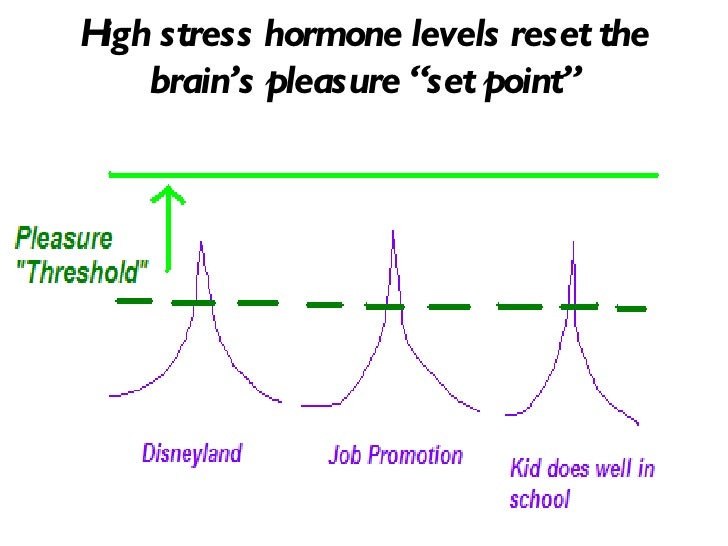
So when I stop drinking, my dopamine levels aren't ever getting anywhere near the hedonic set point which explains the feeling down, depressed, sad, not finding enjoyment in anything. It takes time for the hedonic set point to come back down and for the normal dopamine spikes that come from everyday activities (instead of being artificially spiked way above normal with the use of a drug) to be able to get above that level.

I really like that there is a scientific, biological reason for how I am feeling and proof that it will get better. It helps be realize that I am not just making all of it up.
Ways to fight this boredom until your brain resets:
Keep a recreational activity list I can go to when "bored". Try to do things that I "kind of" like - things that fill me back up such as hiking, yoga, working out, going out to dinner, hanging out with friends, walking my dogs - even if I don;t feel like it. If when finished, I say it was "just ok" - keep doing it. Things may not be "fun or great" yet - don't expect them to be. But, don't stop doing the "ok" things just bc they aren't giving you the same rush of dopamine that alcohol did. Get off the couch, go out and do things and just keep at it. It will get better. I will enjoy things again, it just takes time and sitting around depressed and sad and bored doesn't help.
Give myself things to look forward to. For 30 years I have looked forward to drinking on the weekends after working really hard during the week. I REALLY enjoyed that dopamine rush that alcohol gave me - it was my reward for being such a responsible, hardworking mother, wife, teacher, friend, sister, daughter, etc. I need to replace that with something - a hike, a massage, a trip to the mountains - instead of just doing chores and sitting around being bored all weekend. I need to find a different reward. Not sure what that is yet, but need to keep trying. Being honest, it is hard to replace the dopamine high that I got from alcohol - nothing else seems as "fun" or enjoyable.
Keep a scheduled weekend with interesting activities included. This keeps my "higher thinking brain" in control of my behaviors.
Do something challenging that furthers your personal growth. I am the happiest when being mentally challenged so I'll need to give this one some thought. What new thing could I focus my mental energy on that helps me grow as a person?
In the past I have used my thinking to change my behavior which obviously has not been successful. I think I need to shift to changing my behavior and how I spend my time (even if I don't feel like it ) to change my thinking. Instead of thinking my way out of my addiction I need to behave my way out.
Balance is the opposite of addiction.
Boredom is caused by
1. A structured routine weekend feels differently than an actively drinking weekend.
2. Brain chemical changes during recovery can make people feel flat or bored.
3. Alcohol causes huge emotional swings (high to low and then low to high). Normal emotions can feel flat by comparison.
I am going to try to explain this as well as I understand it. When I drink, it spikes dopamine (the reward/pleasure hormone) in my brain. Then, for me, there is a huge drop the next day (hangover, shame, regret, anger). My dopamine levels looked like a roller coaster - huge spikes Fri-Sat caused by alcohol (probably also Wed-Thurs because of the anticipation of drinking) followed by huge drops Sun-Tues (hangover , shame, anger). I have a hedonic set point of happiness. This the is best image I could find showing this, although it is related to stress instead of addiction.
By spiking the dopamine levels with alcohol every weekend I was resetting my hedonic set point - my threshold for happiness - which also explains tolerance and the need to have more drug to get the same level of pleasure
So when I stop drinking, my dopamine levels aren't ever getting anywhere near the hedonic set point which explains the feeling down, depressed, sad, not finding enjoyment in anything. It takes time for the hedonic set point to come back down and for the normal dopamine spikes that come from everyday activities (instead of being artificially spiked way above normal with the use of a drug) to be able to get above that level.
I really like that there is a scientific, biological reason for how I am feeling and proof that it will get better. It helps be realize that I am not just making all of it up.
Ways to fight this boredom until your brain resets:
Keep a recreational activity list I can go to when "bored". Try to do things that I "kind of" like - things that fill me back up such as hiking, yoga, working out, going out to dinner, hanging out with friends, walking my dogs - even if I don;t feel like it. If when finished, I say it was "just ok" - keep doing it. Things may not be "fun or great" yet - don't expect them to be. But, don't stop doing the "ok" things just bc they aren't giving you the same rush of dopamine that alcohol did. Get off the couch, go out and do things and just keep at it. It will get better. I will enjoy things again, it just takes time and sitting around depressed and sad and bored doesn't help.
Give myself things to look forward to. For 30 years I have looked forward to drinking on the weekends after working really hard during the week. I REALLY enjoyed that dopamine rush that alcohol gave me - it was my reward for being such a responsible, hardworking mother, wife, teacher, friend, sister, daughter, etc. I need to replace that with something - a hike, a massage, a trip to the mountains - instead of just doing chores and sitting around being bored all weekend. I need to find a different reward. Not sure what that is yet, but need to keep trying. Being honest, it is hard to replace the dopamine high that I got from alcohol - nothing else seems as "fun" or enjoyable.
Keep a scheduled weekend with interesting activities included. This keeps my "higher thinking brain" in control of my behaviors.
Do something challenging that furthers your personal growth. I am the happiest when being mentally challenged so I'll need to give this one some thought. What new thing could I focus my mental energy on that helps me grow as a person?
In the past I have used my thinking to change my behavior which obviously has not been successful. I think I need to shift to changing my behavior and how I spend my time (even if I don't feel like it ) to change my thinking. Instead of thinking my way out of my addiction I need to behave my way out.
Balance is the opposite of addiction.
Tuesday, July 17, 2018
7/17/18 8th Group Meeting and Signs of Relapse
I was very disenchanted over the weekend. Sooo tired and unmotivated. No pink cloud. Not sleeping very well. Not getting anything done. Watching way too much tv. Super lazy. Eating junk food. Wondering why I am spending all this time at group and individual therapy. Kind of over the whole group think - listening to everyone else's stories. Was I really bad enough to be spending my whole July doing this again? This is the third summer I have wasted obsessing about alcohol. Questioning if I should stop taking the Zoloft bc it is making me feel weird. Maybe I never needed it in the first place. Nervous about my upcoming sober vacation. Nervous about my new job...elementary teacher for 20 years - moving to a middle school math position. Just kind of being down in the dumps about everything.
I did force myself to go to the meeting yesterday. I was not in a good place for the first half - just getting irritated and impatient with all of the other people there and all of their "needing to be heard". It was being facilitated by my least favorite therapist of the three. After break, however, we talked about signs of relapse and I did learn something new.
In the past I have just tried to ignore any kind of triggers or thoughts about drinking. Just tried to push them out of my head. I tried to ignore them but they would always lead to an irresistible craving that many times I would give in to. The cycle of addiction is "trigger....thoughts .....craving.....relapse". I have always waited to jump in and fight at the craving stage which is ridiculously difficult. When I am having a full on anxiety attack, sweating, heart racing and brain saying "hurry up - just go get a beer - hurry up before you change your mind - hurry - you will be fine", it is so very hard to resist. It isn't even rational thinking at that point. It is the survival mid section of my brain (we learned this in group) overriding my frontal cortex (the rational part) telling me drinking is a survival skill. That is an addicted brain.
I learned that I need to be more proactive during the trigger and thought stage so that it never comes to the craving stage. There are behaviors (not going to group, not blogging, being lazy, not working out, eating poorly, getting irritable, shopping too much, letting my house get dirty, not getting chores done, isolating, not communicating) that start leading to the thought stage (relapse justification - was I ever that bad?, this is stupid, I feel bad anyway so what's the point, I am sure I could moderate if I just tried harder, I don't want to never drink again, I want to hang out with my friends and fit in, one more hangover and I will be done forever, what am I going to do on vacation or with this new job and all these new people who go out on Fridays after work, maybe now isn't a good time to quit).
Right now I absolutely do not want to drink but I am possibly finding myself in the behavior part of relapse...maybe or maybe not...but I need to address it so it doesn't lead me further down the road to relapse. I need to be proactive. I need to go to group, blog, work out, eat healthy, get off the couch and get something done, take my medication, feel productive and get out of my own head. If I do get to the thought stage of relapse, I need to use techniques such as visualization, meditation, the "angel on my shoulder" voice, read my letter to myself about all the reason I don't want to drink. If I ever get to the craving stage, I need to learn techniques like distraction and deep breathing to just be able to wait them out. They do pass.
My dh husband asked me last night if I will always need to go to group. He is not addicted so thinks I can just be cured. I told him that I am learning that I need to fight for my sobriety. I can't be passive about it and then be reactive when I get a craving. I need to learn all I can and keep getting support from like minded people. I can't just stop working at it bc I have been sober for a month or 6 months or a year. The addiction never goes away. It's always there...waiting silently...ready to pounce at any sign of weakness...waiting for me to let it get to the craving stage bc that is when it is strongest and I am weakest. If sobriety is important to me, I need to be proactive and not passive in my recovery. This is a new approach for me and I am ready to work for it.
I did force myself to go to the meeting yesterday. I was not in a good place for the first half - just getting irritated and impatient with all of the other people there and all of their "needing to be heard". It was being facilitated by my least favorite therapist of the three. After break, however, we talked about signs of relapse and I did learn something new.
In the past I have just tried to ignore any kind of triggers or thoughts about drinking. Just tried to push them out of my head. I tried to ignore them but they would always lead to an irresistible craving that many times I would give in to. The cycle of addiction is "trigger....thoughts .....craving.....relapse". I have always waited to jump in and fight at the craving stage which is ridiculously difficult. When I am having a full on anxiety attack, sweating, heart racing and brain saying "hurry up - just go get a beer - hurry up before you change your mind - hurry - you will be fine", it is so very hard to resist. It isn't even rational thinking at that point. It is the survival mid section of my brain (we learned this in group) overriding my frontal cortex (the rational part) telling me drinking is a survival skill. That is an addicted brain.
I learned that I need to be more proactive during the trigger and thought stage so that it never comes to the craving stage. There are behaviors (not going to group, not blogging, being lazy, not working out, eating poorly, getting irritable, shopping too much, letting my house get dirty, not getting chores done, isolating, not communicating) that start leading to the thought stage (relapse justification - was I ever that bad?, this is stupid, I feel bad anyway so what's the point, I am sure I could moderate if I just tried harder, I don't want to never drink again, I want to hang out with my friends and fit in, one more hangover and I will be done forever, what am I going to do on vacation or with this new job and all these new people who go out on Fridays after work, maybe now isn't a good time to quit).
Right now I absolutely do not want to drink but I am possibly finding myself in the behavior part of relapse...maybe or maybe not...but I need to address it so it doesn't lead me further down the road to relapse. I need to be proactive. I need to go to group, blog, work out, eat healthy, get off the couch and get something done, take my medication, feel productive and get out of my own head. If I do get to the thought stage of relapse, I need to use techniques such as visualization, meditation, the "angel on my shoulder" voice, read my letter to myself about all the reason I don't want to drink. If I ever get to the craving stage, I need to learn techniques like distraction and deep breathing to just be able to wait them out. They do pass.
My dh husband asked me last night if I will always need to go to group. He is not addicted so thinks I can just be cured. I told him that I am learning that I need to fight for my sobriety. I can't be passive about it and then be reactive when I get a craving. I need to learn all I can and keep getting support from like minded people. I can't just stop working at it bc I have been sober for a month or 6 months or a year. The addiction never goes away. It's always there...waiting silently...ready to pounce at any sign of weakness...waiting for me to let it get to the craving stage bc that is when it is strongest and I am weakest. If sobriety is important to me, I need to be proactive and not passive in my recovery. This is a new approach for me and I am ready to work for it.
Subscribe to:
Posts (Atom)